

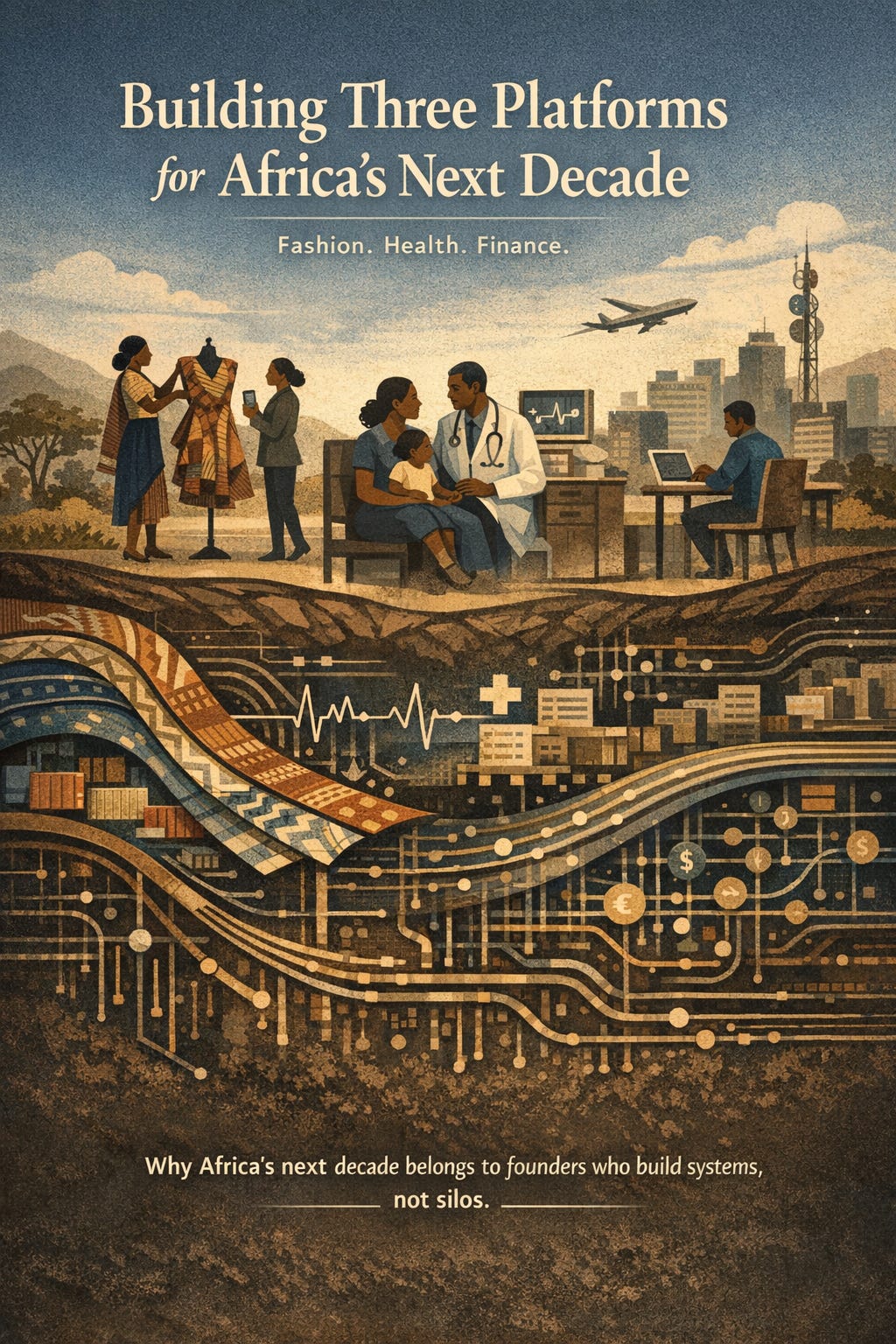
PROLOGUE: WHY I’M WRITING THIS
I’ve been advised more than once not to write this kind of post.
“Focus on one company.”
“Don’t confuse investors.”
“Wait until the exit.”
But Africa doesn’t move in straight lines — and neither do the people building for it.
This essay is not a victory lap. It’s not a pitch deck. And it’s definitely not a personal branding exercise.
It’s an honest account of why I chose to build and establish three platforms across fashion, healthcare, and finance, what I’ve learned along the way, and why I believe Africa’s next decade belongs to founders who think in systems, not silos.
If you’re an operator, investor, policymaker, or builder reading this, my hope is simple:
You leave with clarity, not hype.
THE UNCOMFORTABLE TRUTH ABOUT BUILDING IN AFRICA
Most conversations about building in Africa start with talent gaps or funding shortages. I’ve found those conversations incomplete.
Africa does not lack talent.
It does not lack ambition.
It does not lack demand.
What it lacks are interoperable systems.
We see the symptoms everywhere:
Creators with global demand but no distribution infrastructure
Patients navigating healthcare without continuity of care
Businesses unable to move money across borders efficiently
Too often, startups attempt to solve these problems vertically. They build apps that work well in isolation but fail the moment scale introduces complexity—regulation, logistics, data fragmentation, or cross-border friction.
Early in my journey, I learned a hard truth: Vertical solutions don’t survive continental scale.
Africa’s challenges are layered, not linear. And solving them requires systems thinking—not just product thinking.
This realization shaped everything I’ve built since. It’s why I stopped asking “What app should we build?” and started asking “What infrastructure is missing?”
Over the next few posts, I’ll share why I chose to build platforms across fashion, healthcare, and finance—three sectors that look unrelated on the surface but are deeply interconnected underneath.
This series is not a pitch deck.
It’s not a victory lap.
It’s an operator’s reflection on what it actually takes to build things that last here.
If you’re a builder, investor, policymaker, or operator, I hope this series gives you clarity—not hype.
👉 Next: Why African fashion isn’t a branding problem—it’s an infrastructure problem.