

Introduction: The Ghost in the Ward
Imagine a patient in a rural clinic in Kogi or a bustling hospital in Abuja. They have a history of chronic illness, but their records are trapped in a tattered paper folder five towns away. When an emergency strikes, the doctor isn’t fighting the disease; they are fighting a data blackout.
In Nigeria, we don’t just have a doctor shortage. We have a Trust and Infrastructure shortage.

I. The 20-Year Lens: Why Cybersecurity is the Foundation of Care
For two decades, I have lived in the world of bits, bytes, and breaches. As a cybersecurity architect, I’ve learned one immutable truth: You cannot scale what you cannot secure.
When people ask why I moved from securing global enterprises to building Medlitics, my answer is simple: Healthcare is the most sensitive data environment on earth, yet in Africa, it is the least protected.
Most “Health-tech” startups are building pretty interfaces for a broken foundation. At Medlitics, we are doing the opposite. We are building the Security-by-Design infrastructure first. We aren’t building a “hustle”; we are building a fortress.
II. The “Venture Mindset” vs. The “Founder’s Hustle”
Someone recently voiced the silent frustration of the VC ecosystem: “Investors are not funding your hustle. They are backing systems.”
He’s right. The “hustle” is personality-dependent. It breaks when the founder sleeps.
At Medlitics, we spent our last 30-day growth sprint doing the “unsexy” work that investors actually crave:
Operational Governance: We run board meetings with Fortune 500 rigor.
SOP-Driven Growth: We are documenting every workflow so the system survives the person.
Unit Economics over Hype: We aren’t chasing “users” who don’t pay. We are chasing value that scales.
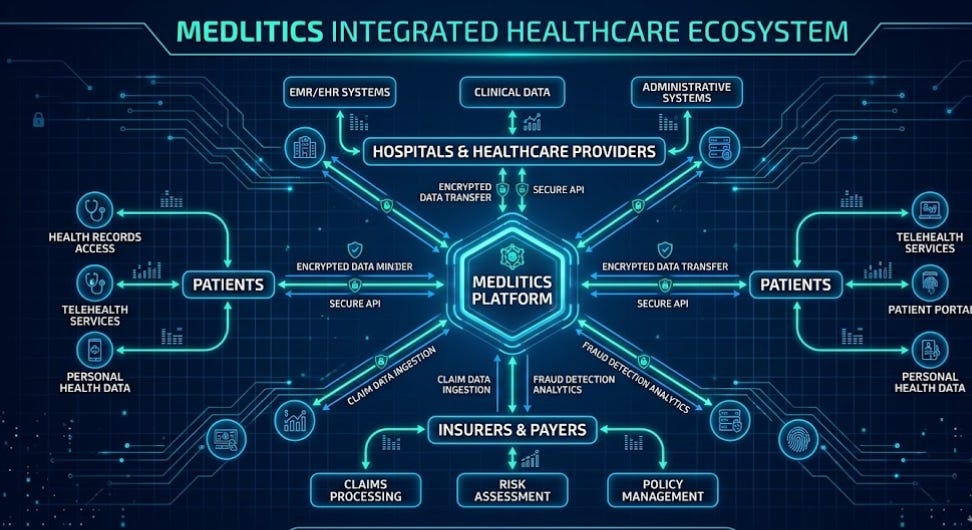
III. The Power of the “Manual Pilot”: Why We Refuse to Build in a Vacuum
Investors often ask, “Where is the traction?”
We believe traction isn’t just a line on a graph; it’s validated behavior. Currently, we are running Manual Pilot Tests. Why? Because before we automate the “nervous system” of a hospital, we must understand the heartbeat of the ward.
By manually bridging the gap between doctors and insurers, we are uncovering the “human friction” that automated apps miss. This “Concierge MVP” approach means:
We validate the willingness to pay before writing a single line of unnecessary code.
We build deep trust with clinical leaders like our CMD, Dr. Degha Fongod.
We ensure the system solves a medical problem, not just a technical one.
This is performance over explanation

IV. Medlitics: The Five-Year Vision for a Unified Continent
We aren’t building for today’s constraints. We are building for tomorrow’s scale.
Our five-year projection isn’t just about revenue; it’s about ecosystem dominance.
Year 1-2: Solidifying the secure data exchange in West Africa.
Year 3-4: AI-driven predictive analytics for chronic care management.
Year 5: The primary secure data partner for regional health ministries.
Conclusion: An Invitation to Builders, Not Just Backers
To the investors who are tired of “hustles” and “apps” that don’t scale: We are building the infrastructure.
We are looking for partners who understand that in the next decade, the most valuable asset in Africa won’t just be the healthcare itself, but the secure systems that make it possible.
Medlitics is ready. The architecture is set. The governance is in place.
Are you backing a hustle, or are you backing a system?
Michael Fasere is the Founder and CEO of Medlitics and the founder and co-founder of Pashione and 1App Technologies. He has over two decades of experience in technology, cybersecurity, and startup building across Africa.